

A hard freeze does not care that the boat is “just in the driveway.” Water left in a livewell, gearcase, or washdown line will split what it sits in. You will leave knowing how to winterize a small outboard boat on a trailer, in the order that actually prevents spring damage.

Most small boats winter in a driveway. Treat the trailer like the hull.
When to Winterize a Small Boat
Start before the first night that stays below freezing where you store the boat. Treat fuel and fluids while you still have a warm afternoon. Cover the boat later. Read the outboard manual first. Newer four-strokes often have a storage mode. Use that instead of a generic fogging routine.
What You Need Before You Start
- Marine fuel stabilizer rated for ethanol-blend gasoline.
- Flushing muffs or the flush fitting your lower unit uses.
- Fogging oil only if the engine maker calls for it.
- Four-stroke oil and filter if you are on the annual service.
- Lower unit gear lube and a pump that fits the drain plug.
- Fuel-water separator element, propylene glycol marine antifreeze, battery maintainer, vented cover.
Stage the parts first.
Treat the Fuel Before You Store a Boat on a Trailer
Ethanol-blend gas pulls water. A half-empty tank grows condensation all winter. On a built-in tank, fill it nearly full, add fuel stabilizer for boat storage at the rate on the bottle, then run the engine long enough to pull treated fuel through the lines and the fuel-water separator.
- Leave a little expansion room. Do not pack the filler neck.
- Replace a dirty fuel-water separator now. Water in the bowl does not improve in January.
- A portable tank on a kicker is often drained and stored off the boat. Follow the engine maker.
If last season’s gas is still in the tank, do not stabilize that varnish and call it done. Drain what you can and start winter on fresh, treated fuel.

Change the fuel-water separator at layup if it is due.
How to Winterize an Outboard Motor
Flush first. Service the fluids while the motor is warm. Protect the insides. Store it so leftover cooling water can drain.
Flush the cooling system
Clamp flushing muffs over the intakes. Hose on first, then the key. Never run an outboard dry. Watch the tell-tale. A weak stream means the muffs slipped or the impeller is tired. Flush until the motor is warm and the thermostat has opened. Saltwater boats get a longer rinse.
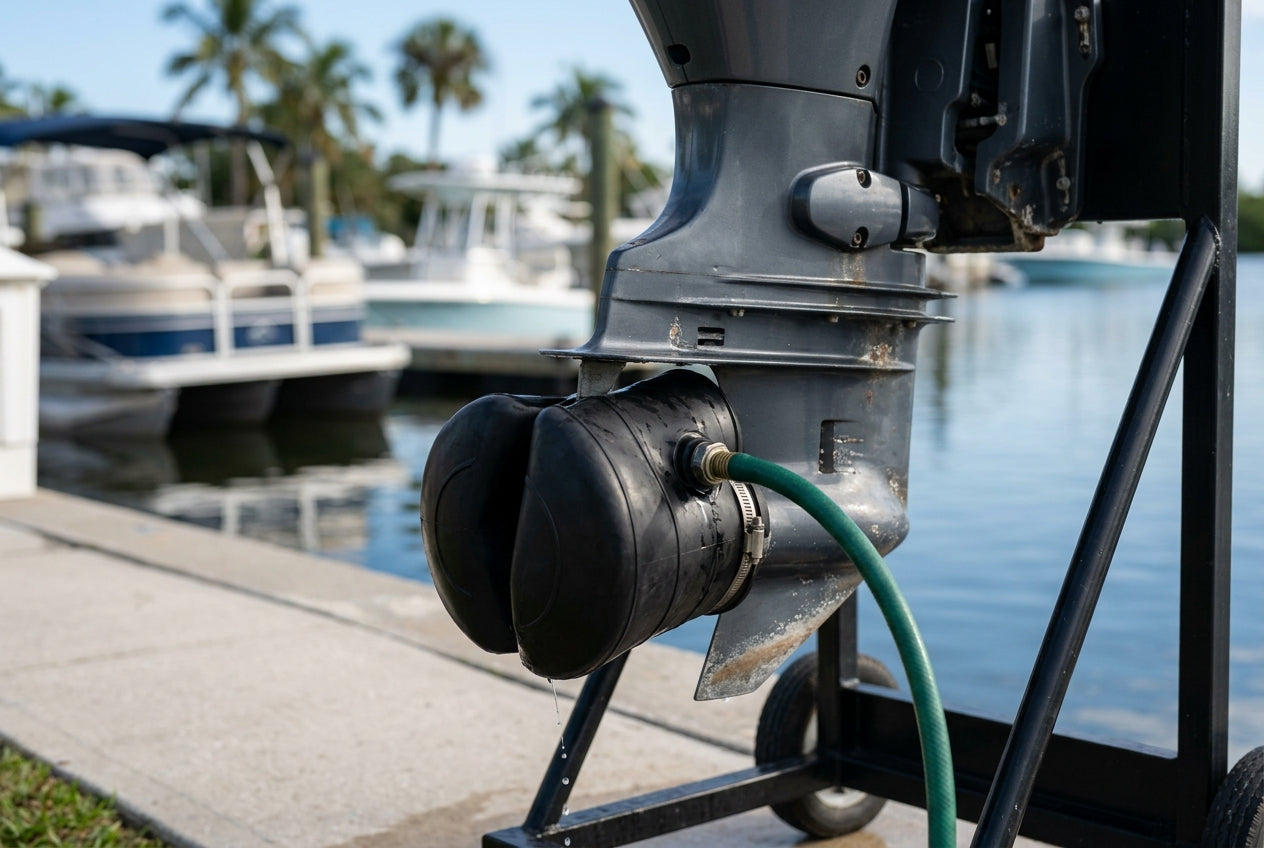
Hose on first, then the key. Never run an outboard dry to “save time.”
Change oil and lower unit gear lube
Warm oil carries more junk out with it. On a four-stroke, drain the crankcase, swap the filter, and refill to the mark in the manual. On every outboard, change the lower unit gear lube. That is the job that saves gearcases.
- Remove the bottom drain plug first, then the upper vent.
- Milky lube means water. Metal flakes mean a shop, not a top-off.
- Pump fresh marine gear lube in from the bottom until it weeps from the top. Fit the top plug first so the case does not drain while you chase the lower one.
- Use new plug gaskets. Reused crushed washers leak.

Drain from the bottom. Fill from the bottom. If the old lube looks like coffee with cream, find the leak before spring.
Fog the engine if the manual says so
Fogging coats cylinder walls so they do not rust in storage. Carbureted engines usually take spray in the intake while the motor runs, then more as it dies. Many EFI four-strokes want a storage additive in the fuel, or a winterize cycle, instead of a can of spray. Follow the cowl sticker.
Store the outboard tilted down
Modern outboards self-drain with the skeg down. Leave the motor in the running position. Tilted up, water can sit in the midsection and freeze. A cowl cover is fine. Sealing the cowl with no vent is not.
Winterize a Livewell, Washdown, and Freshwater System
This is where driveway boats get hurt. The outboard drains. The livewell pump does not.
- Pull the livewell drains. Empty the well. Then winterize a livewell by pulling marine antifreeze through the pump until you see it at the discharge.
- Same method for a raw-water washdown: intake hose in a jug of propylene glycol, run until the nozzle runs pink.
- On a small cruiser with a sink, drain the tank, bypass a water heater if fitted, and pump antifreeze through every faucet.
- Empty seacocks. A closed fitting full of water can split. Leave a helm note if you pull a hose.
- Pump the bilge dry and test the automatic switch. Leave that breaker on if the boat sits outside.
Keep automotive antifreeze out of baitwells and sinks. Use marine propylene glycol.
Batteries, Anodes, and the Rest of the Boat
- Take the battery home or leave it on a marine battery maintainer.
- Clean the posts. Dielectric grease beats a green crust in March.
- Take home portable electronics and anything you do not want mildewed.
- Replace sacrificial anodes that are half gone. Do not paint the new one. Clean the mounting face to bare metal.
- Match the metal to your water: zinc or aluminum in salt, aluminum in brackish, magnesium in freshwater only.
Do Not Skip the Trailer
The boat is only as safe as the trailer it sits on until spring.
- Hose salt off the frame, bunks, lights, and brakes.
- Air the tires. A low tire that sits all winter grows a flat spot.
- Inspect wheel bearings if they growled this season.
- Lock the coupler. Set the jack on a board, not dirt.
- Support the cover so rain does not pond on the console. Vents beat a tarp taped shut.
Common Mistakes When You Winterize a Small Boat
- Leaving the outboard trimmed up “to keep it off the ground.” Store it down so it drains.
- Fogging a motor the maker told you not to fog.
- Stabilizing last year’s varnish and calling it treated.
- Skipping the livewell and washdown because the hull looks dry.
- Pouring automotive antifreeze into a sink or baitwell.
- Leaving a low battery on the trailer with the switch on.
- Painting a new anode, or wrapping the boat in a sealed tarp with no air.
What to Check Before You Buy Winterizing Supplies
- Fuel stabilizer is labeled for marine ethanol blends, not only lawn equipment.
- Flushing muffs cover your intake. Some lower units want a threaded flush fitting instead.
- Gear lube matches the engine maker. Auto-aisle “close enough” is not a plan.
- Antifreeze is propylene glycol for marine plumbing. Color is a dye, not a spec.
- The anode kit matches the engine family and the water you run.
- The cover lists hull length and has vents. The maintainer matches a lead-acid or lithium marine battery.
What to Look for When You Shop
Shop the category first, then the part that fits the boat you already own. Fuel stabilizer, flushing muffs, lower unit gear lube, a fuel-water separator element, marine antifreeze, a sacrificial anode kit, a battery maintainer, and a fitted cover will handle almost every trailered outboard in this class.
If you only do five things: treat fresh fuel, flush the motor, change the gear lube, empty every pump, and store the outboard down under a cover that can breathe.